Sourcing Spray Foam Chemicals: Direct From Manufacturer vs. Through a Distributor
Where your chemical comes from affects pricing, lead time, technical support, and how much flexibility you have when a job needs a formulation you don't normally stock. Most contractors land on one of two models.
The manufacturers actually in the market
Names you'll see and hear regularly in the SPF chemical space include Lapolla, Rhino Linings, Icynene (part of Huntsman), Demilec, NCFI Polyurethanes, BASF (Elastospray line), and Covestro. These are established, verifiable companies with their own formulation lines, technical data sheets, and (in most cases) their own dealer or distributor networks.
Buying direct from the manufacturer
Larger and more established contractors more often buy direct, which can mean closer access to manufacturer technical support, earlier visibility into formulation changes (like the HFO blowing agent transition), and sometimes better volume pricing at scale. The tradeoff is usually less flexibility — direct relationships often come with minimum order commitments or brand loyalty expectations that a smaller or newer operation may not be ready for.
Buying through a regional distributor
Many mid-size and smaller contractors buy through a regional distributor instead. Distributors typically carry multiple manufacturer lines, which gives a contractor more flexibility to switch formulations or brands as jobs or pricing dictate, plus more accessible order sizes and often faster local pickup or delivery than shipping direct from a manufacturer. The tradeoff is an extra layer between you and the manufacturer's own technical support team, and potentially less favorable pricing than a large direct account would get.
How chemical actually ships
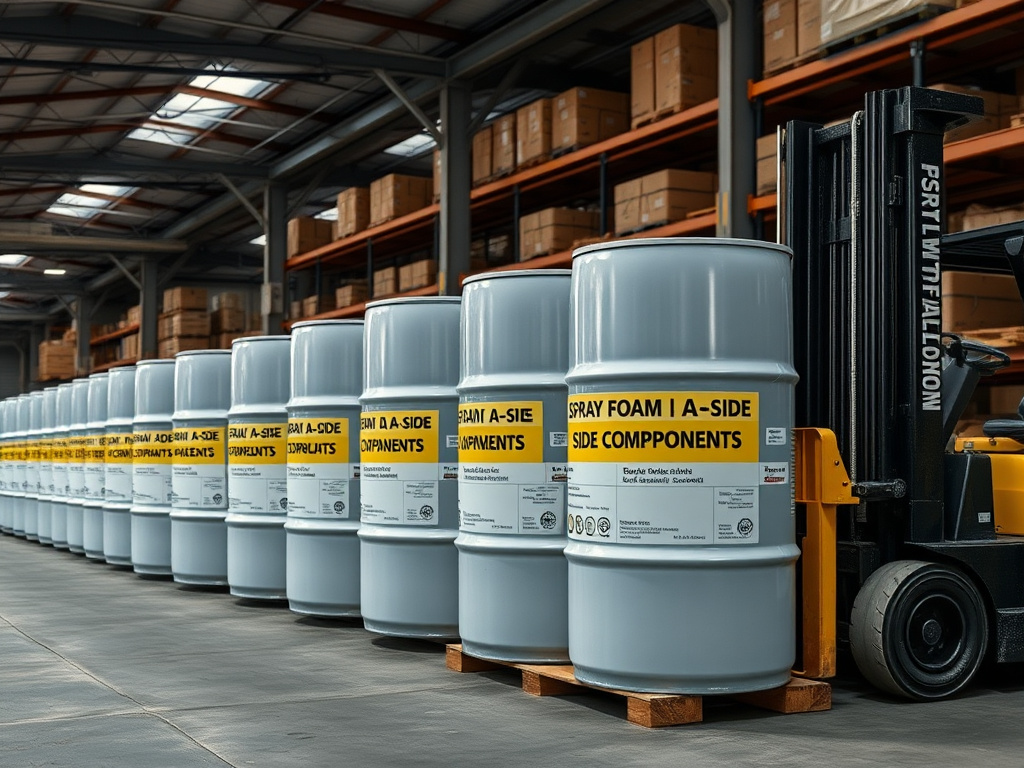
Chemical typically ships as 55-gallon drum sets — one A-side drum paired with one B-side drum per set, each drum weighing roughly 400-500 lb. How many board feet you get out of a set depends on the specific product's formulation and target density; that yield figure is published by each manufacturer for their own line and isn't a fixed industry-wide constant, so estimating material needs for a job should be based on the actual chemistry being used.
What actually moves your material cost
- MDI and polyol pricing tracks broader petrochemical feedstock markets — crude oil and related derivatives
- The HFO blowing agent transition has generally cost more than the legacy HFC blowing agents it's replacing
- Freight and drum deposit/return logistics add real, sometimes overlooked cost
- Seasonal demand swings affect availability and, at times, pricing
Frequently asked questions
It depends on your volume, need for flexibility across brands, and how much you value direct manufacturer technical support versus faster local availability. Larger, established contractors more often buy direct; many mid-size and smaller operators prefer the flexibility of a distributor relationship.
In 55-gallon drum sets — one A-side (isocyanate) drum and one B-side (resin blend) drum per set, each weighing roughly 400-500 lb.
Petrochemical feedstock pricing (since MDI and polyol are petrochemical derivatives), the cost of HFO blowing agents relative to the HFCs they replaced, freight and drum logistics, and seasonal demand all play a role.
Running a business this guide touches on?
Get your company listed in the SprayFoamHQ directory so contractors and builders researching this topic can find you.